

Day 3 – August 2nd
By the third day of Vagos Metal Fest, exhaustion had begun to make itself felt. Two days of relentless heat, dust, headbanging, and crowded pits had already taken their toll, yet Saturday offered no opportunity to slow down. With a programme that moved freely between alternative metal, death metal, folk, goregrind, punk, hardcore, black metal, and Portuguese industrial metal, the festival entered its most stylistically diverse—and arguably most unpredictable—day.
Iznutri were entrusted with opening proceedings on the Illegal stage. As had become customary throughout the festival, the first performance of the afternoon came with the difficult combination of intense heat and a relatively small audience. Nevertheless, the people who had already gathered in front of the stage were rewarded with an energetic blend of hard rock and alternative metal, occasionally reinforced by heavier and more atmospheric passages. With much of the performance centred on their latest album, “Reach the End,” the band opened with “The Beast” before moving into the record’s title track. Frontman and guitarist Alexey Dugin remained highly communicative throughout the concert, repeatedly encouraging the audience to become involved. “Blood on Your Face” introduced an additional visual element through the presence of a dancer, who initially joined the musicians onstage before continuing to animate the performance from the pit. By the final song, Dugin was confident enough to request a wall of death. Despite the limited number of people present, the audience complied. It was an enthusiastic beginning to another demanding day.
A substantial dose of death metal arrived with Switzerland’s Nihilo. By this point, the area in front of the Vagos stage had become considerably more populated, allowing the band’s fast and uncompromising sound to produce the first major clouds of dust of the afternoon. Benefiting from a clear and powerful sound mix, Nihilo delivered material from several stages of their discography, including “Fueled by Suspicion” and “Deceptive World.” Vocalist Ragulan Vivekananthan commanded the performance with tireless energy and constant interaction, while the musicians maintained an impressively solid and disciplined delivery behind him. The concert also carried additional significance: it marked the final date of the band’s tour and the last performance by guitarist Nils Hugi following 18 years in the group. “Submerged” and “Antichrist” brought the set to a suitably violent conclusion, ending one chapter of the band’s history with considerable force.
Following the extremity of Nihilo, Italy’s Ironwill offered a more traditional and emotionally driven form of heavy rock / heavy metal. Led by guitarist Salvo “Ironwill” Dell’Arte, the project presented itself with male vocals rather than the female-fronted or dual-vocal configurations associated with some of its studio work, missing Sherrie Grieve. This gave the material a different character and, in a live setting, made the band sound heavier and more organic. Their performance provided a welcome contrast within a day dominated by punk and extreme metal. Dell’Arte maintained an open and friendly relationship with the crowd, while the interactions between the musicians brought an element of spontaneity to the set. Older material was represented by songs such as “Infinity,” from the debut album “Jonathan’s Journey,” while the band also used its time at Vagos to introduce forthcoming compositions like “The Ship”. Another new song, “Falling,” was dedicated to Ozzy Osbourne, creating one of several tributes to the late singer heard throughout the festival.
Any sense of restraint disappeared with the arrival of Austria’s VxPxOxAxAxWxAxMxC. The full meaning behind the band’s abbreviated name—“Vaginal Penetration of an Amelus with a Musty Carrot”—already offered a reasonably accurate indication of what was about to happen. Performing without a drummer and using programmed percussion, the musicians appeared in bloodstained aprons and immediately transformed the Vagos stage into a showcase of goregrind absurdity. Their sound was chaotic, deliberately excessive, and fronted by vocals so distorted that they often resembled a non-human sound effect rather than a conventional growl or pig squeal. Songs such as “Slushy Baby,” “Embryos Orgasmen,” and the agriculturally destructive “Lacerate Some Farmers With a Harvester” provided the soundtrack to a performance built equally around brutality and comedy. The vocalist, whose stage name is Franz Stockreiter, also decided that ordinary festival activities had become outdated. In their place, he introduced the “blind wall of death,” during which participants covered their faces with their shirts, and the “domination circle pit,” which involved women riding on the backs of male participants. It was ridiculous, grotesque, and thoroughly entertaining—exactly as intended.
Furor Gallico then brought a very different atmosphere to the Illegal stage. As the only folk metal representatives on the 2025 bill, the Italians provided an effective change of texture without sacrificing the heaviness expected from the festival. Opening with “Call of the Wind” and “Among the Ashes,” both taken from the 2024 album “Future to Come,” the group established a sound in which violin, flute, and bouzouki were woven naturally into forceful metal arrangements. Rather than relying exclusively on the celebratory side of folk metal, Furor Gallico favoured something darker, more intense, and more epic. Davide Cicalese’s guttural delivery was balanced by the clean female vocals of Claudia Beltrame, while the traditional instrumentation introduced melodic space between the heavier sections. The quieter “Canto D’Inverno” provided one of the set’s most contemplative moments before “The Phoenix” returned the concert to full intensity. Furor Gallico delivered a convincing performance and offered a valuable shift in atmosphere before the programme entered its long-awaited punk section.
That section began with one of Portugal’s most enduring institutions: Mata-Ratos. Members of the audience were already chanting the band’s name. Those chants were soon replaced by the opening of “Raça Humana”, one of the band’s best songs, which immediately sent the crowd into motion. There was little subtlety and even less compromise in what followed. Mata-Ratos delivered a raw, energetic and careless performance, led by Miguel Newton, a figure known to everyone by now, letting out all his frustrations and message with his characteristic vocal style. His confrontational delivery gave songs such as “Sai da Minha Vida”, “Xu-pa-ki”, the fun “Napalm na Rua Sésamo,” “C.C.M.,” and “Besta Humana” the same sense of urgency that has sustained the band for decades. The audience required no encouragement to participate. A large circle pit remained active for much of the set, while familiar lyrics were shouted back at the stage by a crowd that clearly knew the material. With songs such as “Tsunami de Cerveja,” “És um Homem ou És um Rato” also appearing during the performance, Mata-Ratos offered both a celebration of their history and a reminder that their abrasive spirit remains firmly intact.
Serrabulho are normally associated with the final hours of Vagos Metal Fest, having previously closed the event with some of its most memorable parties. Seeing them perform in daylight was unusual, but the earlier schedule did nothing to reduce the scale of the chaos. Part of the audience was covered by a foam cannon, and quickly combined with the dust to produce mud. Inflatable objects, beach balls, costumes, stuffed animals, and a succession of unexpected characters turned the stage and surrounding area into something halfway between a grindcore concert, a village celebration, and a collective loss of reason. Singer Guerra repeatedly crossed the boundary between performer and audience, jumping from the stage and moving directly through the crowd during key moments such as the traditional “ass of death”, along with an enormous circle pit around the venue and a specially arranged pit for couples—further evidence, according to the band’s internal logic, that Serrabulho are fundamentally a romantic group. Songs such as “Sweet Grind O’Mine,” “Dingleberry Ice Cream,” “Piss or Love”, “Pentilhoni Nu Culhoni”, and “Toco Loco du Moi” accompanied the confusion. By the time the concert ended, the festival grounds had been physically transformed, and very few people remained clean. Serrabulho once again proved that beneath all the props and comedy lies a band with an exceptional ability to control and entertain an audience.
The Exploited followed with a considerably more serious form of disorder. More than four decades after becoming one of the defining names of British punk, Wattie Buchan and his band arrived at Vagos with the same hostility towards authority, war, and political power that has always characterised their work. “Let’s Start a War (Said Maggie One Day)” opened a set compiled of fast, direct, and uncompromising punk. At the age of 68, Wattie remained surprisingly energetic and as verbally confrontational as ever. Between songs, he addressed contemporary political subjects with the same lack of restraint found in the band’s lyrics. He mocked the American national anthem, while “The Massacre” was dedicated to the Palestinian people. The political content never overshadowed the physical intensity of the show. Circle pits and crowdsurfing remained constant as the band moved through more than 40 years of material. The landmark album “Punk’s Not Dead” occupied an important part of the set through songs including “Army Life” and “Cop Cars”. The final sequence provided the concert’s defining image. During “Sex & Violence,” members of the audience were invited onto the stage, filling the available space around the musicians and bringing the performance to an appropriate conclusion. The “Punk’s not dead” slogan may be more than four decades old, but at Vagos it sounded less like nostalgia and more like a statement of fact.
The punk and hardcore lineage continued with Black Flag. Greg Ginn, the band’s founder and only constant member, arrived with an entirely renewed and considerably younger lineup: David Rodriguez on bass, Bryce Weston on drums, and Max Zanelly as the first female lead vocalist in Black Flag’s history. Such a substantial change inevitably required some adjustment, particularly for longtime followers familiar with the many vocalists who have passed through the group, and especially those who are used to Henry Rollins’ style. However, the new formation proved cohesive onstage. Opening with “Can’t Decide” and “Nervous Breakdown,” Black Flag built a set around seminal hardcore material such as “Wasted,” “I’ve Had It”, “Forever Time”, “My War,” and “Gimmie Gimmie Gimmie.” Ginn’s guitar playing retained its dirty, abrasive, and deliberately uncomfortable character, while Zanelly approached the material without attempting to replicate any of her predecessors. Her physical performance was intense, and her rasping vocals introduced a distinct personality to the songs. Between them, she adopted a much warmer manner, speaking directly with the crowd and eventually addressing it in Portuguese. “Rise Above” produced the expected surge of recognition near the end, before the band closed with its version of Richard Berry & the Pharaohs’ cover of “Louie Louie.” Black Flag may now exist in a markedly different form, but the concert demonstrated that their music still carries a rawness capable of connecting punk history with a new generation.
By then, anticipation had reached its highest point. Mayhem had been among the earliest names announced for the festival and remained one of the central attractions of the entire edition. Their performance was conceived not simply as a conventional concert, but as a chronological descent through more than 40 years of history. Archival images and videos appeared on the screen behind the stage, documenting former members and the events that helped construct the band’s mythology. Under dense and oppressive red lighting, the musicians emerged with “Malum,” from “Daemon,” beginning a journey backwards through their discography. “Milab” represented “Esoteric Warfare,” while the long and unsettling “Illuminate Eliminate” introduced a more atmospheric section associated with “Ordo Ad Chao.” Attila Csihar was the master of ceremonies, with his unavoidable presence, changing costumes as the retrospective moved from one period to another. The rest of the musicians maintained a colder and more distant presence, reinforcing the sense that the audience was witnessing a ceremonial act rather than a conventional performance.
Going back in time came “Chimera”, “Crystalized Pain in Deconstruction”, one of the songs where Hellhammer’s drumming stands out. Then “Ancient Skin” continued the journey through successive eras. Sadly “Fall Of Seraphs” and “Symbols Of Bloodswords” were left out. Soon after that, another historical video introduced the material that many had been waiting for. When the first notes of “Freezing Moon” emerged, the reaction was immediate. “Life Eternal” and “Funeral Fog” made quite an impact while “De Mysteriis Dom Sathanas” became the sole highlight of the band’s show, transforming the final section into a celebration of one of black metal’s most influential records and songs. Unfortunately, due to time restrictions, Mayhem were forced to cut songs from the show, and returned for a final assault with “Deathcrush”, having to cut “Chainsaw Gutsfuck,” “Carnage,” and “Pure Fucking Armageddon” from the set. Rather than presenting only a collection of familiar songs, Mayhem had constructed a carefully staged account of their own history—one that used sound, costume, lighting, and archival imagery to turn their past into theatre.
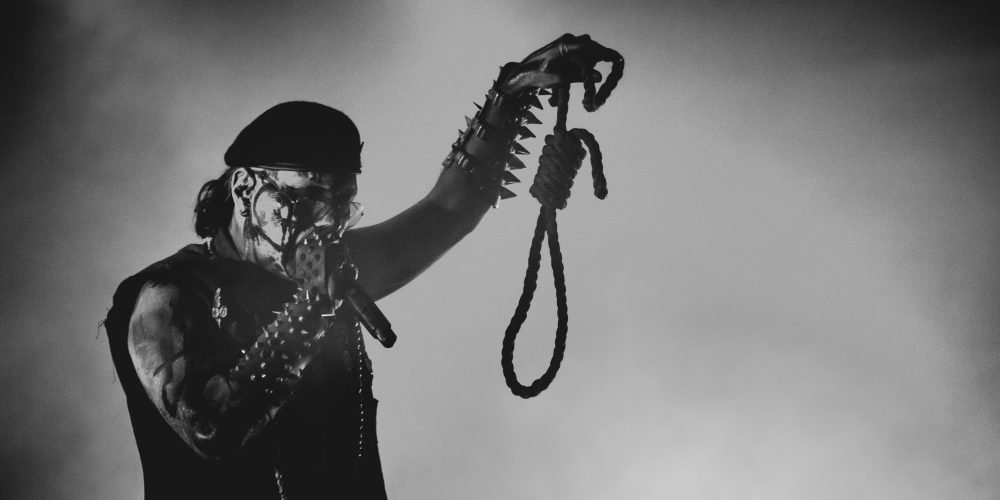
Despite the scale and intensity of Mayhem’s performance, the third day was not yet over. A substantial part of the audience remained in place for Bizarra Locomotiva, who were given the responsibility of closing the night on the Illegal stage. Few bands possess such an immediately recognisable combination of industrial metal, electronics, theatricality, and violence. From the moment the band began, the physical exhaustion accumulated across the previous concerts seemed temporarily irrelevant. Rui Sidónio once again proved himself to be one of the most commanding frontmen in Portuguese heavy music, moving with an almost convulsive intensity and shifting between screams, whispers, and apocalyptic declarations, like a tiger locked in a cage. With the great “Volutabro” album to promote, songs such as “Vendaval Utópico,” “Volúpia” and “Vejo-me Fantasma” convinced whoever still needed any convincing that Bizarra are an unstoppable force. “Mortuário” and “Ergástulo” contributed to a performance that felt both mechanical and deeply human. The programmed rhythms and industrial textures created a crushing foundation, but the emotional weight of the Portuguese lyrics prevented the concert from becoming cold or impersonal. The final section gained an additional presence when Moonspell vocalist Fernando Ribeiro joined the band for “O Anjo Exilado” and “O Escaravelho.” His voice complemented Sidónio’s theatrical delivery, and the evident familiarity between the two singers transformed the collaboration into more than a simple guest appearance.
Bizarra Locomotiva closed the third day not with comedy or spectacle for its own sake, but with a form of collective catharsis. After the brutal death metal massacre of VXPXOXAXAXWXAXMXC, the Serrabulho party, jumping onto the punk rebellion of Mata-Ratos, The Exploited, and Black Flag, followed by Mayhem’s historical descent into darkness, the Portuguese industrial veterans provided one final release. The audience left physically exhausted, covered in dust and foam, but still aware that one complete day of the festival remained.




Comments are closed.